An international entomological expedition will bring together researchers, enthusiasts, conservationists, and genomics experts in the Kresna Gorge this June
For the first time, Bulgaria will host such a scientific expedition of this scale, bringing together over 50 entomologists, genomics experts, conservationists, and enthusiasts from Bulgaria, Sweden, the Czech Republic, Slovakia, Belgium, France, Austria, Poland, Romania, Italy, Germany, Turkey, Estonia, Serbia, Finland, Spain and the United Kingdom.
Scientists from leading research institutions, including Lund University, Stockholm University, the Biology Centre of the Czech Academy of Sciences, the Centre for Functional and Evolutionary Ecology at the University of Montpellier, the Wellcome Sanger Institute, Nicolaus Copernicus University in Toruń, and the National Museum of Natural History at the Bulgarian Academy of Sciences will gather in the village of Vlahi in the Kresna Gorge from 15 to 19 June 2026. Together, they will exchange expertise and carry out fieldwork in search of rare and elusive butterfly species.
The National Museum of Natural History at the Bulgarian Academy of Sciences will be actively represented in the expedition by organisers Prof. Stoyan Beshkov, Sen. Assist. Dr Stefania Kamenova, Assist. Ana Nahirnić-Beshkova, together with the PhD student Zdravko Kolev, and museum’s associate researchers Assoc. Prof. Boyan Zlatkov and Dimitar Kaynarov. They will take part in the fieldwork, species identification, and processing of the collected material.
The aim of this large-scale initiative is to sequence the genomes of all butterfly and moth species which occur in Europe and to carry out population genomics studies. To achieve this goal, the expedition brings together an open community of scientists, amateur entomologists, and all those interested in analysing or using genomic data to study and conserve Lepidoptera biodiversity. One of the greatest challenges for scientists working to sequence the genomes of all Lepidoptera species in a given region is collecting specimens according to appropriate protocols that ensure high-quality material for genetic analysis. The assembled genomes will serve as reference genomes for their respective species, which requires precise and reliable species identification by leading specialists in the relevant taxonomic groups.
The use of the reference genomes from Bulgaria is recognition of the quality of science in Bulgaria, and in particular of lepidopterology.
Of the approximately 11,000 butterfly and moth species recorded in Europe, some are easy to find and identify, while many others are difficult to determine in the field or have highly restricted local distributions. The Balkans, and Bulgaria in particular, are among the regions with high species diversity and endemism, yet they remain underrepresented in international DNA and genomic databases. The use of reference genomes from Bulgaria is a recognition of the quality of scientific research in the country, and of Bulgarian lepidopterology in particular.
The expedition will bring together teams working within three research projects:
— COST Action CA23122 “10kLepGenomes” (https://10klepgenomes.eu) is a collaborative European research network funded by the European Cooperation in Science and Technology. The initiative operates as a cornerstone for the broader Project Psyche and aims to mobilise massive genomic datasets of European butterflies and moths (Lepidoptera) to address pressing issues of biodiversity loss, climate change, and pest control.
— Project Psyche “Lepidopteran genomes for Europe” (https://www.projectpsyche.org) is a pan-European research project, the aim of which is to sequence the genomes of all species of butterflies and moths in Europe in order to support their study, conservation and protection.
— Project LepEU “The European Lepidopteran Population Genomics Consortium” (https://lepeu.github.io/organisation.html) is a continent-wide, community-driven research network launched in 2023. It focuses on the whole-genome sequencing of butterflies and moths to monitor biodiversity, track population resilience, and study evolutionary adaptations across Europe.
By bringing together specialists from diverse scientific fields and geographic regions, the expedition in Vlahi will strengthen international collaboration and promote the exchange of knowledge and innovation capacity in biosystematics and evolutionary biology.
The specimens collected in Bulgaria, together with their expert taxonomic identification, will provide a valuable contribution to the study of Lepidoptera genomic diversity in Europe and mark an important step towards establishing a regional hub for genomic analyses in the Balkans.
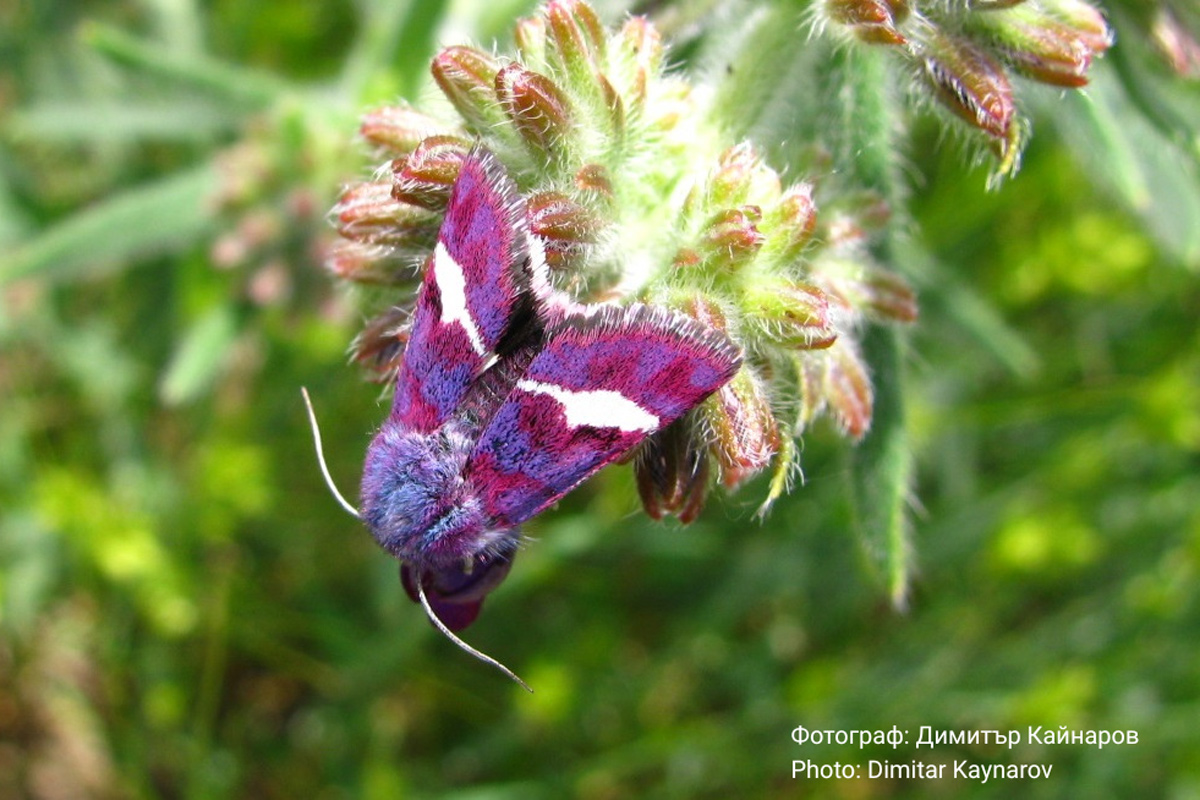
As emblematic species of the expedition was chosen the newly described in 2025 species Janthinea forsterorum, family Noctuidae. The species is a Balkan endemic, occurring only in a small number of localities in Bulgaria, Republic of North Macedonia, and Greece.
The expedition is funded by Project Psyche Lepidopteran genomes for Europe, Wellcome Sanger Institute, COST Action CA23122 10kLepGenomes, LepEU: European Lepidopteran, Population Genomics Consortium and National Museum of Natural History, Sofia and is carried out in partnership with the Institute of Biodiversity and Ecosystem Research — Bulgarian Academy of Sciences, Faculty of Biology, Sofia University and Large Carnivore Education Centre of the Balkani Wildlife Society.